Mathematics for Machine Learning
Foundations, Tools, and Techniques
Overview
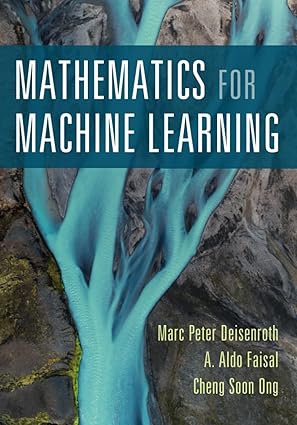
Mathematics for Machine Learning provides a comprehensive introduction to the essential mathematical concepts that underpin modern machine learning algorithms. Written for students and practitioners in computer science, engineering, and data science, the book bridges the gap between mathematical theory and practical machine learning applications. It covers foundational topics such as linear algebra, calculus, probability, and optimization, emphasizing intuitive explanations alongside rigorous derivations. This makes it an invaluable resource for those looking to deepen their understanding of the math driving algorithm design and analysis.
Why This Book Matters
This book serves as a critical resource in the AI and ML ecosystem by demystifying the complex mathematics that often act as a barrier for newcomers and non-mathematicians. Its unique approach focuses on clarity, accessibility, and relevance to modern machine learning techniques, including deep learning and probabilistic modeling. By combining theory with practical examples and exercises, it empowers learners to gain the confidence required to innovate and apply mathematical insights directly to real-world ML problems. This foundational understanding is vital for advancing in research, improving algorithm performance, and contributing to the evolving AI landscape.
Core Topics Covered
1. Linear Algebra
Linear algebra is the backbone of most machine learning algorithms, providing the language and tools for dealing with data in high-dimensional spaces.
Key Concepts:
- Vectors, matrices, and operations
- Eigenvalues and eigenvectors
- Singular value decomposition (SVD)
Why It Matters:
Understanding linear algebra allows practitioners to manipulate data efficiently, optimize computations for algorithms like PCA, and comprehend how models transform input data. It is crucial for both theoretical understanding and implementing effective machine learning solutions.
2. Probability and Statistics
Probability theory provides the framework for modeling uncertainty and making inferences from data, which is fundamental in machine learning.
Key Concepts:
- Random variables and distributions
- Bayes’ theorem
- Expectation, variance, and conditional probability
Why It Matters:
Probabilistic reasoning enables the design of algorithms that can learn from noisy data, quantify uncertainty, and make predictions. This topic underlies many models in supervised, unsupervised, and reinforcement learning domains.
3. Optimization
Optimization techniques are essential for training machine learning models by minimizing cost or loss functions.
Key Concepts:
- Gradient descent and variants
- Convex optimization
- Constrained optimization
Why It Matters:
Optimization drives the learning process, allowing models to improve performance iteratively. Efficient and robust optimization methods are key to scaling algorithms and achieving high accuracy in diverse applications from neural networks to support vector machines.
Technical Depth
Difficulty level: 🟡 Intermediate
Prerequisites: Basic calculus, introductory linear algebra, and high school-level probability are recommended before engaging with this book. The content builds on these foundations to cover more advanced concepts without assuming extensive prior experience with formal mathematics.